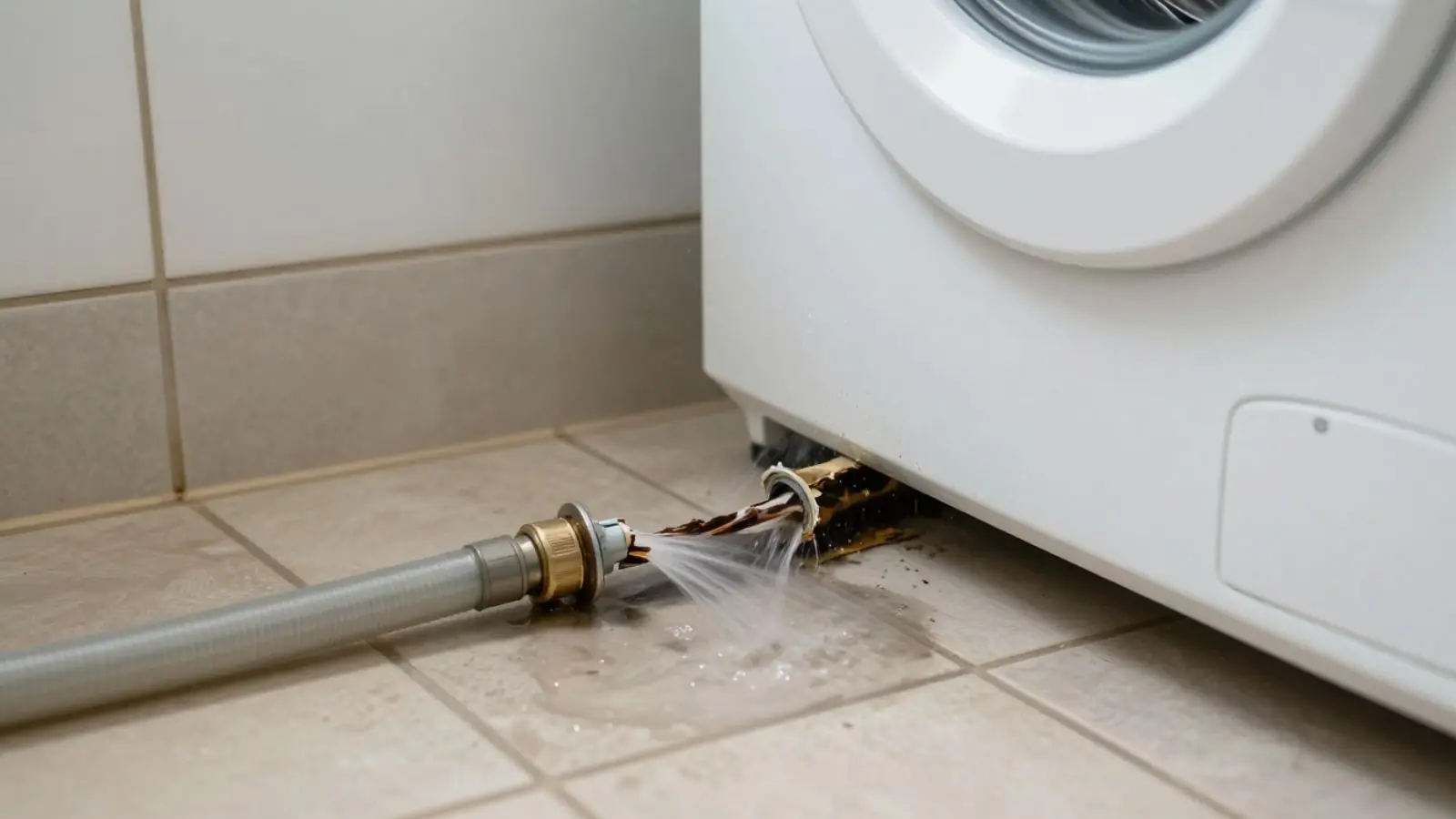
Appliance leak water damage in Flower Mound, TX starts at a hose, valve or drain connection and ends wherever the water finds a low spot. Close the supply valve for the failed appliance now, then call our 24/7 dispatch line and describe what you see. Same-day response is available when crews are free, and the first job is finding how far the water traveled.
Which Appliance Failed Decides Where the Water Went
Each appliance leaks in its own way, and the failure point tells a crew where to look first. Starting from the appliance is faster than checking the whole house, because water from a supply hose behaves differently from water out of a drain line.
| Appliance | Common failure point | Where the water tends to go |
|---|---|---|
| Washing machine | Rubber supply hose at the wall box, or a drain hose that slips out of the standpipe | Across the laundry floor, then under the wall into hallway flooring or the room below |
| Dishwasher | Inlet valve, supply fitting or drain hose clamp | Under the machine, into the cabinet base and the subfloor beneath it |
| Refrigerator or ice maker | Thin supply tubing, saddle valve or fitting behind the unit | Beneath the toe space and under flooring, often out of sight |
| Garbage disposal | Mounting flange, drain gasket or discharge elbow | Down the sink base and across the cabinet floor |
| Sink and faucet connections | Supply stops and braided connectors | Into the cabinet base, then along the back wall |
Water heaters and air conditioner condensate lines are separate problems. For a tank that is leaking, see water heater leak cleanup. This page covers the machines that plug into your supply and drain lines.
Washing Machine Hoses and Drain Standpipes
A washer holds two pressurized hoses that sit behind the machine, so a bulge or a drip can go unseen for a long time. A hose that bursts under line pressure moves a lot of water quickly, while a standpipe that overflows pours drain water over the back edge of the machine.
If your laundry sits on an upper floor, water leaves through the floor edge and drips into the room below. Check the ceiling directly under the laundry for a stain or a bubble in the paint. Wet insulation above that ceiling is a sign that more than the surface needs attention.
If your washer sits in a garage or on an exterior wall, cold weather adds a risk. The National Weather Service Fort Worth normals show DFW averaging 29 freezes per season, so look at hose connections on cold mornings. A cracked fitting can start to drip after the temperature climbs.
Washer or dishwasher water on the floor? Call the 24/7 line and describe the path.
☎ (817) 623-9267Dishwasher, Ice Maker and Disposal Leaks Under Cabinets
A dishwasher leak is hard to catch because the machine sits inside a cabinet run. Water slips under the unit and soaks the particleboard base and the subfloor, and the first sign is often a soft spot in the flooring at the dishwasher edge. A musty smell near the sink base is the other clue.
Ice maker lines are thin and drip slowly. That slow drip is the reason many of these losses are discovered late. The room-level work that follows, including cabinets, countertops and flooring, is covered on our kitchen water damage restoration page.
Disposal leaks usually come from the flange seal or the drain elbow under the sink. A paper towel held under each joint while the water runs will show which connection is weeping. Check the cabinet floor for swelling, because the drip tends to collect there.
Safety First: Shut Off, Unplug, Stay Out
- Close the small supply valve behind or beside the appliance. If it will not turn, close the main water valve for the house.
- Unplug the appliance only if the outlet and the floor in front of it are dry. Never reach behind a machine while standing in water.
- If water is touching an outlet, power strip, breaker panel or anything that sparks, leave the area and call 911 or the electric utility first.
- If you smell gas near a gas dryer or range, leave the house and call the gas utility or 911.
- Pull the machine out only if the floor is dry, so you can see the connections without lifting it over a wet surface.
- Take photos and video of the leak, the hose and the wet area before anything is moved.
Keep the failed hose or part. An insurer or plumber may want to see it, and the break pattern shows whether the failure was sudden or slow. Dispatch will tell you what to do next based on what you describe.
Our Process: Trace, Open, Dry, Document
Trace the path
A technician starts at the failed connection and uses a moisture meter and a thermal camera to follow the water through flooring, cabinet bases and walls.
Remove standing water
A wet vacuum or small extractor pulls water off the floor and out of the cabinet base.
Open what holds water
A toe-kick, a cabinet back or a strip of baseboard comes off so air can reach the cavity. Soaked pad or insulation is removed.
Dry and monitor
Air movers and a low grain refrigerant dehumidifier run until readings return to the reference level taken from a dry part of the home.
ANSI/IICRC S500 is the reference worth asking about when a company describes how it dries appliance spills. Appliance water that comes from a supply line is typically clean when it first escapes. A drain line carries used water, which changes what must be removed, so the crew asks which line failed.
Not sure which line failed? Call and a dispatcher will walk through it with you.
☎ (817) 623-9267What Changes the Cost of an Appliance Leak
- How long the leak ran before it was found, since longer exposure reaches the subfloor and walls.
- Whether the water came from a supply line or a drain line, which sets what must be removed.
- The flooring type and how many layers sit under the appliance.
- Whether the water dropped through a floor into a room below.
- How much cabinet base, baseboard or drywall must come out to dry the cavity.
Dispatch explains the scope and price before work starts. A short leak caught the same day often needs a few days of drying and little removal. A leak that ran for weeks behind a unit can involve flooring and cabinet work.
Insurance: Sudden Failure Versus a Slow Seep
The Texas Department of Insurance says most homeowner and renter policies cover sudden and accidental water damage, and it names a broken washer hose as an example. It also says gradual leaks and seepage are generally excluded, including the mold they cause. A hose that burst yesterday and a fitting that wept for months land on different sides of that line.
TDI advises that you photograph or film the damage before repairs, keep damaged items until the adjuster has seen them, and make temporary repairs to prevent more damage. Keep your receipts. Our crews record moisture readings and photos at each visit so you have a dated record. Your policy decides coverage, so check it or ask your insurer.
Prevention: Hoses, Shutoffs and Drain Pans
- Look at each washer hose for bulges, rust at the collar and cracks, and replace any that show wear.
- Turn washer valves off when you travel, or when the laundry will sit unattended for days.
- Run a dry paper towel along dishwasher and sink connections every few months.
- Set a drain pan with an overflow line under any machine on an upper floor.
- Do not push a refrigerator tight against the wall, since that kinks the supply tube.
We serve homes across Flower Mound, including ZIP codes 75022 and 75028, and neighboring towns like Lewisville and Argyle. If the water is already beyond the appliance, the rebuild stage follows under water damage repair.
Frequently Asked Questions
Dispatch is 24/7, including nights, weekends and holidays. Same-day response is available when crews are free. Call, describe the appliance and the wet area, and a dispatcher will tell you what to do while the crew is on the way.
Only if the outlet and the floor around it are dry. If water has reached the outlet or a power strip, stay out and call 911 or the electric utility first. Shut the washer supply valves as the first move.
Look for a soft or spongy spot near the front of the dishwasher, swollen cabinet edges and a musty smell. A moisture meter gives a firm answer, and a thermal camera shows the wet area without removing anything.
The Texas Department of Insurance lists a broken washer hose as sudden and accidental damage, which most policies cover. A slow seep is treated differently. Your policy wording controls, so check it and ask your insurer.
Yes, if it runs through the floor edge. Check the ceiling under the laundry for a stain, bubbled paint or sag. Wet insulation above may need to come out, so mention any ceiling sign when you call.
Keep it. Photograph it where it broke, then set it aside. A plumber, an adjuster or your insurer may want to see how it failed, and the break shows whether it failed suddenly or over time.